Recent WWA Publications
Life Cycle Water Use For Electricity Generation
March 2013

This report provides the foundation for conducting water use impact assessments of the power sector while also identifying gaps in data that could guide future research. Read the full article at Environmental Research Letters.
Meldrum, J., S. Nettles-Anderson, G. Heath, and J. Macknick, 2013. Environmental Research Letters 8.
Water Use for Electricity in the United States
February 2013

Significant differences between reported and calculated water data are evident, yet no consistent reason for the discrepancies emerges. Read the full article at Environmental Research Letters.
Averyt, K., J. Macknick, J. Rogers, N. Madden, J. Fisher, J. Meldrum, and R. Newmark, 2013. Environmental Research Letters 8.
The Water Implications of Generating Electricity
December 2012

This study explores potential changes in water use by the US electric sector over the next four decades under various low carbon energy scenarios, nationally and regionally. Read the full article at Environmental Research Letters.
Macknick, J.S. Sattler, K. Averyt, S. Clemmer, and J. Rogers, 2012. Environmental Research Letters 7.
Mountain Pine Beetle Infestations and Nitrate Concentrations
December 2012

MPB infestations have not resulted in significant increases in nitrate concentrations in Colorado streams. Read the full article at Proceedings of the National Academy of Sciences.
Rhoades, C.C., J. H. McCutchan, L.A. Cooper, D. Clow, T.M. Detmer, J.S. Briggs, J.D. Stednick, T.T. Veblen, R.M. Ertz, G.E. Likens, W.M. Lewis, Jr., 2013. Proceedings of the National Academy of Science 110(5), 1756-1760.
WWA Spotlight
WWA's Lisa Dilling publishes chapter on climate adaptation success
![]() |
Building on work from multiple WWA research projects, WWA's Lisa Dilling, along with Rebecca Romsdahl of the University of North Dakota, recently published a chapter entitled "Promoting Adaptation Success in Natural Resource Management Through Decision Support: Lessons from the Great Plains and Rocky Mountain Regions." Dilling and Romsdahl's chapter is in Successful Adaptation to Climate Change: Linking Science and Policy in a Rapidly Changing World, edited by Susanne Moser and Maxwell Boykoff. |
WWA contributes to analysis of Southwest’s climate future
![]() |
In an era of increasing climate instability, the southwestern United States faces strained water resources, greater prevalence of tree-killing pests, and potentially significant alterations of agricultural infrastructure. These threats and challenges as well as others are detailed in the new book, “Assessment of Climate Change in the Southwest United States.” Read more ... |
WWA 2012 Annual Report available
![]() |
Each spring, WWA reports to NOAA on the program's accomplishments over the previous calendar year. Download the WWA 2012 Annual Report. |
Layers of dust on Colorado mountains to impact snowmelt and runoff
WWA's Jeffrey Deems was quoted in a Denver Post article on southwestern dust found in snow across Colorado mountains. Excerpt from the article:
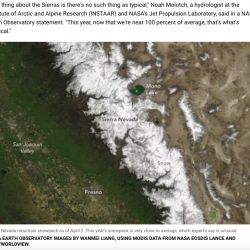
Dust blown in from the Southwest settled on snow over many of Colorado's mountains during this week's storm and will eventually affect how fast the snowpack melts and possibly how much water the state can hold onto. Researchers say the dust kicked up from Arizona, New Mexico and Utah by southwesterly winds fell in Steamboat Springs, Summit County, Vail, Aspen and the San Juan mountains. Dust was also scattered in the snow that fell along the Front Range, but it's likely that dust could have been carried by southeasterly winds from other areas too, including parched southeastern Colorado, the San Luis Valley and the Arkansas River Basin. Read more.
How much water will our future electricity generation portfolio require?
A new paper by WWA's Kristen Averyt, along with collaborators at the National Renewable Energy Laboratory and the Union of Concerned Scientists, explores how freshwater withdrawals by electric power plants could change under a number of future electricity generation scenarios. Their analysis includes aggregation of results by second-order hydrologic units in order to accommodate how basin-level differences in water availability affect generation. Their paper is available freely here and is part of a broader "Focus on Electricity, Water, and Climate Connections" published in the journal Environmental Research Letters.
Understanding and harmonizing estimates of life-cycle water use for electricity generation
In order to better compare water used in the entire life cycles (manufacturing through operation) of electric generation options, WWA's James Meldrum, along with collaborators at the National Renewable Energy Laboratory, developed a three-step methodology to assess existing data. Their findings indicate that thermoelectric generation facilities appear to use the most water, while photovoltaic and wind resources use the least. An article on their findings is available here and is part of a broader "Focus on Electricity, Water, and Climate Connections" published in the journal Environmental Research Letters.